A WORKING REALITY

Results and References

A Working Reality

The Learning OS is not a future promise.

It is a working pedagogical system.

It was born in everyday school practice, and it proved its viability there.

It became part of the daily life of the lower grades in a partner school. It did not function as a separate experiment or a temporary project, but as an integral part of teaching.

The system became embedded in school operation through:

  • an independent, weekly learning-foundation lesson;
  • a curriculum developed for four grades;
  • professional support materials for teachers;
  • methods and exercises that can be integrated into subject lessons;
  • student workbooks and project tasks;
  • demonstration lessons and classroom observations;
  • a shared professional outlook and pedagogical language;
  • continuous professional cooperation and feedback.

Under its former name, the Mind Management Program, the program became part of the school’s pedagogical program. It appeared as a separate lesson slot in every grade of the lower school, while its approach and methods were gradually integrated into subject teaching as well.

Validation here is not an after-the-fact decoration. It is the examination of how the Learning OS works in everyday school reality.

The value of the system is shown not only by the theoretical model it creates, but also by how it appears in children’s development, in classroom work, in the institution’s durable practice, and in the experiences of teachers, parents and children.

The question is simple:

“Does the system work where learning takes place day after day?”

The measurement results, institutional integration, teacher experience, parent feedback and children’s voices all point in the same direction.

The Learning OS does not simply give children new tasks. It strengthens an inner operating foundation on which knowledge can be built securely, and from which children’s learning can continue to develop in new situations as well.

The teacher, parent and child quotations come from documented written feedback; on the public page, we publish them anonymously.

The Five Levels of Validation

We examine the functioning of the Learning OS from five different perspectives.

1. Measurement Results

The competency assessment summary shows how the performance of a class working with Learning OS changed between the entry assessment in grade 1 and the assessment at the end of grade 4.

2. Institutional Integration

The school’s pedagogical program, timetable structure, curricula, reports, projects and professional cooperation show how Learning OS becomes a lasting institutional practice.

3. Teacher Experience

Teachers’ observations show how teachers’ reading of children’s functioning changes, and how children’s engagement, expressive ability, cooperation and task handling develop.

4. Parent Feedback

Parents can see how the abilities developed in the program appear in life outside school: in family relationships, in sport, in problem-solving, in the handling of emotions and in more independent behaviour.

5. Children’s Voices

Children’s own words show how Learning OS gradually shifts from an external pedagogical language into an internal language of functioning and an increasingly self-usable tool.

“Measurement shows the change in performance. Institutional experience shows whether the system can be embedded. The teacher shows the change in functioning. The parent shows transfer into life situations. And the child shows internalization.”

Competency Assessment Results

From a less favourable starting position to above the comparison values

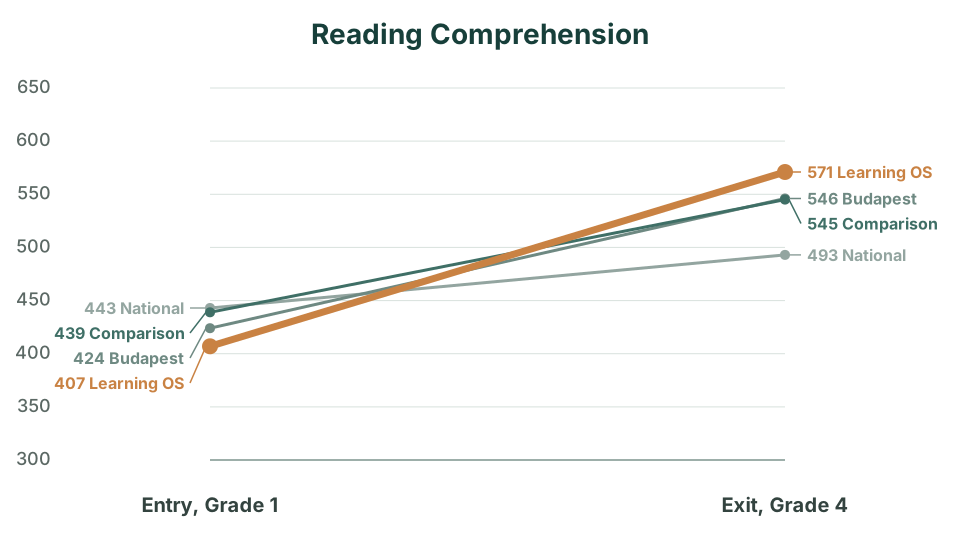
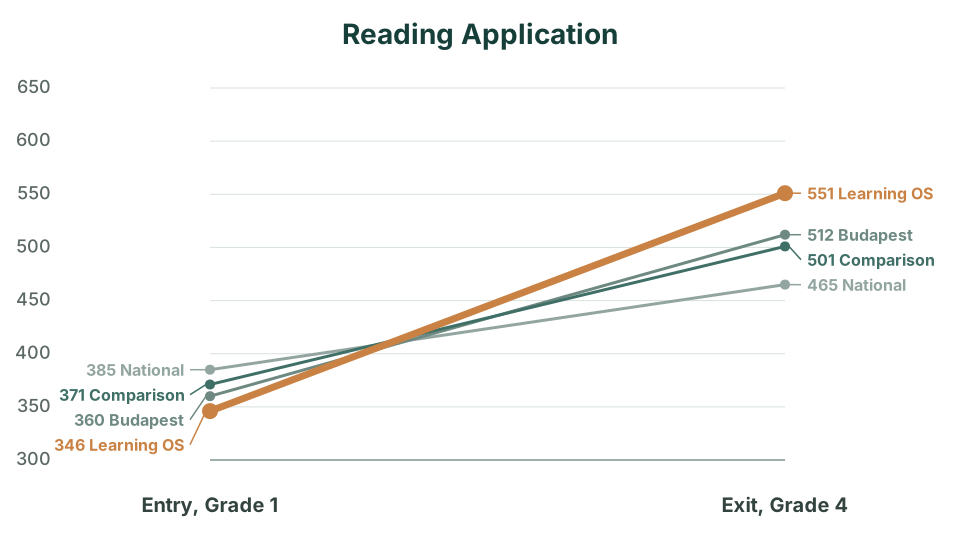
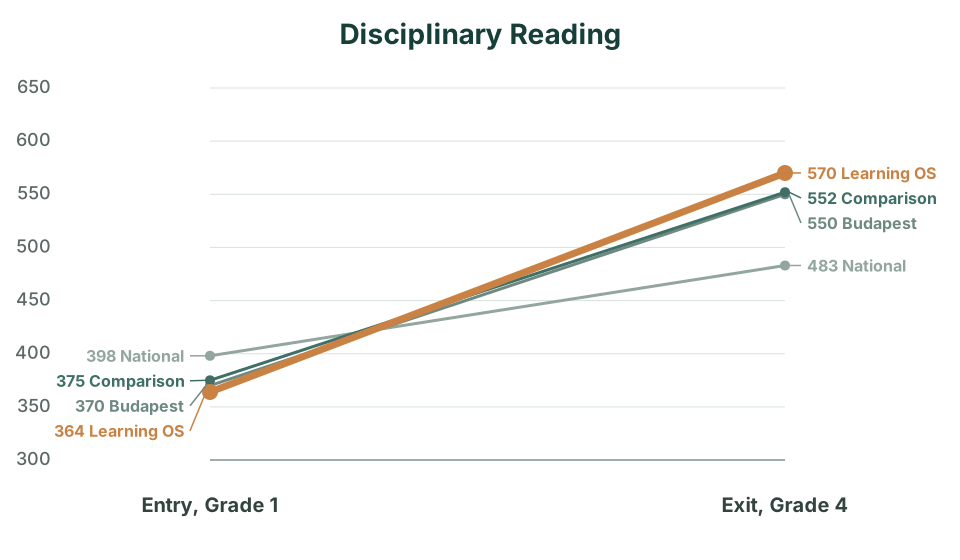
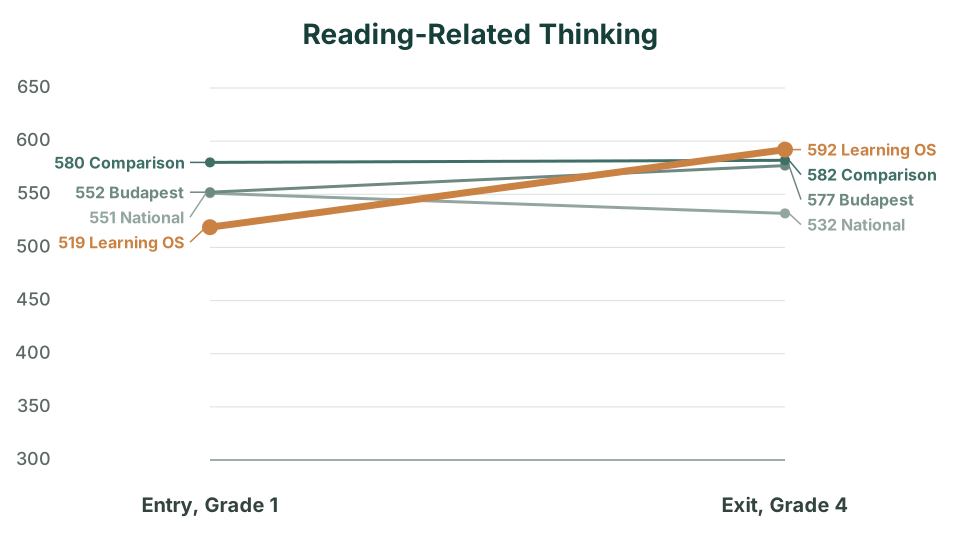
The summary of competency assessment results from the University of Szeged places side by side, across four reading domains:

  • the national average;
  • the Budapest average;
  • the result of a measured comparison class;
  • the result of the Learning OS class.

At the entry assessment in grade 1, the Learning OS class started with lower scores in all four examined domains than the national average, the Budapest average and the comparison class.

By the end of grade 4, it had risen above all three comparison values in all four domains.

Results measured at the end of grade 4:

Examined domainLearning OS in Grade 1Learning OS at the end of Grade 4Change
Reading Comprehension407571+164
Reading Application346551+205
Disciplinary Reading364570+206
Reading-Related Thinking519592+73
Examined domainNational averageBudapest averageComparison classLearning OS class
Reading Comprehension493546545571
Reading Application465512501551
Disciplinary Reading483550552570
Reading-Related Thinking532577582592

Compared with the comparison class at the end of grade 4, the Learning OS class achieved higher scores by:

  • 26 points in reading comprehension;
  • 50 points in reading application;
  • 18 points in disciplinary reading;
  • 10 points in reading-related thinking.

These results are also shown in the following diagrams:

Reading comprehension comparison from Grade 1 entry to Grade 4 exit
Reading Comprehension: from 407 to 571, from the lowest entry score to the highest exit score.
Reading application comparison from Grade 1 entry to Grade 4 exit
Reading Application: from 346 to 551, 50 points above the comparison class at exit.
Disciplinary reading comparison from Grade 1 entry to Grade 4 exit
Disciplinary Reading: from 364 to 570, 18 points above the comparison class at exit.
Reading-related thinking comparison from Grade 1 entry to Grade 4 exit
Reading-Related Thinking: from 519 to 592, the highest exit score.

Why is the starting position important?

The significance of the results is not defined only by the end point in grade 4.

At the grade 1 assessment, the Learning OS class was below the comparison values in every examined domain.

By the end of grade 4, in every examined domain, it:

  • surpassed the national average;
  • surpassed the Budapest average;
  • surpassed the measured comparison class result.

This was not a group that merely maintained an already outstanding position. It was a class starting from a less favourable position that built strong output performance.

The largest score increases appeared in the reading application and disciplinary domains. In these domains, children must do more than recognise or repeat what they have read. They must also use it, organise it into relations, and make it function in a task situation.

This is especially close to the basic idea of Learning OS.

The result of learning is not simply that the child possesses some information. It is also that the child can access it, interpret it, and use it in a concrete world of tasks.

What do the results show?

The results show that over the four years of lower primary school, the performance of the Learning OS class improved across all four examined reading domains.

This developmental trajectory is in line with the core pedagogical assumption of Learning OS:

If, in the first school years, we do not only drill tasks but also consciously develop the general system of functioning that carries task performance, a stronger foundation is built for later achievement.

Reading performance rests on a complex inner functioning. The child must:

  • perceive and notice accurately;
  • maintain attention;
  • form a multimodal image;
  • organise the content through speech and concepts;
  • retrieve prior memories and knowledge;
  • recognise relations;
  • hold on to the task goal;
  • follow their own line of thought;
  • notice deviations;
  • and make corrections when needed.

The measurement result becomes visible in the TES — that is, in the concrete world of task performance.

Learning OS builds the Mind OS from which this performance can emerge.

Institutional Reference

When a program truly becomes part of school operation

The real test of a pedagogical innovation is whether it can be integrated into the school’s lasting operation.

Does it gain a place in the pedagogical program?

Can it be fitted into the timetable?

Does it work across multiple grades?

Can it be handed over to multiple teachers?

Are the necessary curricula and tools created for it?

Does it appear in subject teaching?

Does professional cooperation develop around it?

According to the partner-school documents, the program:

  • was included in the institution’s pedagogical program;
  • appeared in every grade of the lower school;
  • received an independent weekly time slot;
  • was built on a four-grade curriculum and professional books;
  • used printed and digitally available support materials;
  • was linked to demonstration lessons, classroom observations and professional discussions;
  • was integrated into teachers’ everyday subject teaching as well;
  • became visible in student products, projects and portfolios.

The school leadership provided a regular lesson slot and the opportunity for professional discussion.

At the beginning of every school year, the teachers clarified the aims and tasks of the program together. The year’s work was evaluated in reports. Lesson observations, student work and completed projects made implementation traceable.

The curricula, books, guides, charts, drawings and other support materials made the program transferable for teachers working in the lower school.

New teachers entering the program received consultation and support. In demonstration lessons, they could become familiar with the methods and tools. Lesson observations were followed by joint analysis and feedback.

Learning OS did not arrive at the school as a guest program. It became part of how the school works.

What does the institutional recommendation say?

“The strength of the program lies in the part developed for the lower grades; this is where it works particularly well. Its effectiveness is demonstrated by student work and the projects that were carried out.”

From a school-leader recommendation

Teacher Experience

Reading the functioning instead of the symptom

One important effect of Learning OS appears in teachers’ professional way of seeing.

On the classroom surface, the teacher often sees this:

  • the child does not begin the task;
  • leaves the sentence unfinished;
  • gets the calculation wrong;
  • drifts away;
  • rushes;
  • remains silent;
  • resists;
  • does not finish the work.

The teacher language of Learning OS opens a new question:

Which inner function was unable to support task completion strongly enough?

Was the child’s attention in place?

Did the child perceive and notice the instruction accurately?

Did the child have a usable multimodal image?

Could the child formulate what needed to be done?

Could the child retrieve the necessary prior memory?

Could the child bear the emotional load?

Did intention and goal form within the child?

Could the child plan and organise the action?

Did the child notice the deviation?

Did the child have a corrective tool?

The teacher’s attention thus extends from the finished answer to the functioning behind the answer.

Behind a wrong mathematics task there may be attentional noise.

Behind an unfinished sentence there may be weakness in inner speech.

Behind an empty notebook there may be inability to start.

Behind a hurried response there may be a breakdown in guiding thought.

Behind clowning around there may be escape from emotional overload.

Behind unfinished work there may be difficulty with planning, organisation or closure of action.

The functioning map shows more precise points for intervention.

The teacher can say more than:

“Pay better attention!”

The teacher can lead the child back to a concrete internal operation:

  • “Show me where you lost the thread.”
  • “Say out loud what you understand so far.”
  • “Let’s form an image of the situation.”
  • “What do you remember from a similar task earlier?”
  • “What should the goal be?”
  • “What should the first step be?”
  • “What do you need to prepare?”
  • “Where did the result diverge from your goal?”
  • “What can you change right now?”

What do the teacher references highlight?

Teacher documents name several recurring experiences.

Work with Learning OS supports:

  • recognition and management of emotions;
  • acceptance of other people’s thoughts;
  • verbal expressiveness;
  • reading comprehension;
  • creativity;
  • problem-solving;
  • independent project work;
  • presentation and communication;
  • social cooperation.
“The children really look forward to the lessons when we work with this program. They are enthusiastic, and they have good insights and comments on the different topics.”

From a fellow teacher’s recommendation

“Students create presentations and communicate about different topics with growing confidence. This knowledge continues to be useful for students who learned through the program even in the upper grades.”

From a primary teacher’s recommendation

The feedback does not merely signal satisfaction. It describes children’s engagement, their independent speaking-up, their expressive ability, and their communicative competence that remains usable in later school situations as well.

The references also document the development of teachers’ work through:

  • the use of shared curricula and support materials;
  • consultation with newly joining teachers;
  • demonstration lessons;
  • lesson observations;
  • joint analysis of lessons;
  • integration of experience;
  • continuous development of methods.

Learning OS thus does not function as a closed recipe book.

It functions as a learning pedagogical system.

Upper-grade feedback

One real test of lower-grade development is the upper school.

There:

  • more subjects appear;
  • children must adapt to more teachers;
  • they have to work with longer texts;
  • the demand for independent learning increases;
  • more complex projects and oral responses appear.

The experience of upper-grade teachers can be summarized in one short sentence:

“These are children you can really work with.”

They pay attention.

They think.

They initiate.

They have ideas.

They like to perform and present.

They are able to work in projects.

They do not simply wait for the next instruction; they participate in shaping and carrying out the task.

This sentence may sound simple, but in fact it indicates a complex pedagogical result.

It means that the child does not merely know something.

The child is functional in the learning situation.

Parent Experience

When development steps beyond the school gate

The effect of Learning OS appears not only in notebooks and measurement results.

The following quotations come from written responses in parent questionnaires.

Parents can see how the child functions:

  • at home;
  • in family relationships;
  • in conflicts;
  • in sporting situations;
  • in uncertainty;
  • in times of change;
  • while solving problems.

Parent feedback highlights several kinds of change:

  • greater self-knowledge;
  • more precise recognition of feelings and emotions;
  • better recognition of relationships and connections;
  • more complex cause-and-effect thinking;
  • greater creativity;
  • calmer handling of emotionally difficult situations;
  • persistence in critical situations;
  • recognition of previously learned instructions and their application in new situations;
  • a more sensitive relationship to peers and family members.

Transfer to new situations

“Instructions heard during sports practices and training camps are later recognised and successfully applied during practices and matches in critical situations.”

From a parent’s feedback

This observation is not about repeating a single practiced response. The child recognises, retrieves and applies a previously learned way of functioning in a new, high-load situation.

Emotional presence and persistence

“When he senses that my nerves are stretched to the breaking point, he turns into an incredibly patient, calm psychologist who knows what upset me and patiently says exactly what can calm me down.”

From a parent’s feedback

“In critical situations, for example during matches, he remains composed and does not give up.”

From the same parent feedback

Self-knowledge and thinking

“He has come to know himself, his feelings and his emotions better.”

From a handwritten parent comment

“A better understanding of connections, a more complex grasp, and an interpretation of cause and effect.”

From another parent’s feedback

Parent voices show that development becomes visible not only in school performance. It also appears in self-knowledge, relationships, handling pressure, persistence, and the complexity of thinking.

The workbook as a point of return

“To this day, the child still takes out the workbook and flips through it, especially when a related topic comes up.”

From a parent’s feedback

The workbook thus did not remain simply a completed school workbook.

It became a tool of memory and self-interpretation.

The child could return to it when he or she:

  • encountered change;
  • wanted to understand a feeling;
  • was trying to interpret a social situation;
  • was looking for a point of support in an earlier experience.

Several parents also indicated that they would consider continuation of the program valuable in the upper grades as well. They saw it as especially important for adolescent changes, self-confidence, self-expression, social relationships and the parent-child relationship.

The child begins to use the functional tools built at school in family, social and sports situations as well.

Children’s Voices

When the child begins to speak about their own functioning

One of the deepest results of Learning OS appears when the child begins to speak more precisely about what is happening inside.

Young schoolchildren often can only say: “I don’t understand.” “I can’t do it.” “I forgot.” These are honest signals, but they reveal little about where the functioning got stuck.

The goal of Learning OS is not to teach a new technical jargon, but to support the child in recognizing and directing their own functioning with age-appropriate words ever more precisely.

The child does not formulate things in scientific language.

The child speaks from lived experience:

  • “It got foggy.”
  • “I lost the thread.”
  • “I don’t have a picture of it yet.”
  • “It became too much at once.”
  • “I’m going back to where I still understood it.”
  • “I’ll cover the rest.”
  • “I’ll put it into words.”
  • “I’ll make a statement.”
  • “I’ll correct it.”
  • “I’ll start again.”

These are not decorative expressions.

They are tools of functioning.

When inner functioning becomes nameable, the possibility of conscious change opens up.

Feedback from a fourth-grade child

In a handwritten student evaluation, one child wrote that their favourite topic was change:

“I really like this part because we learned how to handle changes.”

The child also highlighted that the lessons dealt with:

  • the conscious mind;
  • exclusion;
  • the handling of emotions;
  • accepting other people’s thoughts.
“I recommend spreading Mind Management to everyone, because it is useful for recognizing and managing our emotions, and also for getting to know and accepting other people.”

From a handwritten fourth-grade student comment

The child does not merely report that they liked the lesson. They name what they learned about dealing with change, recognizing emotions, and getting to know and accept other people.

Recognizing the fog

The first major step is when the child notices that the task is not accessible at the moment.

Earlier, the child may only have felt:

  • it doesn’t work;
  • it is too difficult;
  • I need to escape;
  • someone help me;
  • I’d rather not do it.

Now the child can say:

“It’s foggy.”

The nameless blockage thus becomes a named state of functioning.

The child can already look at what is happening inside.

The possibility of change

The next step is that the child learns to change either their own functioning or the task situation:

  • slows down;
  • covers the distracting part;
  • reads it again;
  • says the step aloud;
  • forms a mental image;
  • draws;
  • searches for an earlier memory;
  • breaks it into smaller units;
  • asks for help;
  • chooses another method.

The child participates in restoring their own functioning.

The child does not merely wait for the next external instruction.

The new meaning of error

In Learning OS, error is functioning data. It is not a final judgment on the child, but information about where and how the outcome of action diverged from the intended goal. It helps reveal where the process needs to be revisited, what needs to be changed, and what can be corrected or further developed.

The child gradually learns to ask themselves:

  • Where did I diverge from the goal?
  • What did I misunderstand?
  • Which step did I leave out?
  • What do I need to change?
  • What can I correct?
  • What can I learn from this for the next time?

Error thus does not close learning down; it launches the next step of thinking and action.

The child does not become identified with the error. The child learns to work with it.

What Do the Five Levels Mean Together?

The validation of Learning OS takes shape from five complementary perspectives.

Measurement shows

The performance of the Learning OS class showed clear improvement between Grade 1 and Grade 4. By the end of grade 4, it exceeded the national, Budapest and comparison-class values listed in the summary in all four examined reading domains.

Institutional documents show

The system can be integrated into the school’s pedagogical program, timetable, grade-level work and professional cooperation.

Teacher experience shows

Learning OS gives teachers a more precise map for reading functioning, a shared professional language and a development process that can be guided more consciously.

Parent feedback shows

The abilities developing in the children also become active in family, social, problem-solving and sports situations.

The child’s voice shows

The external pedagogical language gradually becomes the child’s internal language of self-guidance.

Together, the five perspectives draw a fuller picture of the system. The numbers, the institutional documents and the direct human voices reinforce one another in showing how Learning OS becomes a working school reality.

Measurement shows the change in performance.

The institution shows lasting integration.

The teacher shows classroom functioning.

The parent shows transfer into life situations.

The child shows internalization.

Learning OS appears at once in performance, in school culture, in teacher perception, in everyday life situations, and in the child’s own language of functioning.

A Working Reality

The basic proposition of Learning OS is that visible student performance rests on an inner foundational system of functioning.

This foundational system can be built consciously.

If the child:

  • pays attention and notices more accurately;
  • holds themselves together better emotionally;
  • forms a multimodal image;
  • grasps and guides thought through speech;
  • retrieves an earlier memory;
  • chooses a goal;
  • plans and organises;
  • follows their own action;
  • notices error;
  • changes and corrects,

then the child increasingly begins to work from a more orderly inner functioning.

The value of Learning OS appears not only in correct answers or successfully solved tasks. It also becomes visible in those moments when, in a situation where the child previously got stuck, the child is now able to function differently:

stops;

looks again;

understands;

judges;

changes;

corrects;

and returns.

The deepest form of validation is when the child not only solves a task, but becomes increasingly able to guide the inner system from which the solution is born.